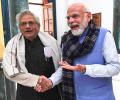
Sitaram Yechury strived to have the country's Left movement shed its doctrinaire approach to India's socio-cultural complexities and stitch electoral and social alliances to fight the Sangh Parivar.

The CPI(M) leader said when the Nepali people overcome these obstacles, they shall create history by transforming this Himalayan Hindu kingdom into a modern democratic nation state based on democracy.
In an interactive programme at Rajbiraj, an eastern Nepal town, Prachanda claimed that his party Communist Party of Nepal - Maoist would get 150 seats out of a total of 300 seats in the direct election, and that he will become the first president of the Himalayan nation after the polls. He also sounded a note of apprehension over elections taking place on the scheduled date. "I am not confident that the CA elections will be held on the stipulated date," he said.
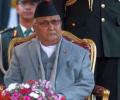
'The redrawing of the map with the inclusion of Kalapani area by Nepal and endorsement from the House of Representatives shows the KP Oli government's move to gain cheap popularity in the name of nationalism'
The interrogation of top Maoist leader Kobad Ghandy, who is currently in the custody of Delhi police's Special Cell, has confirmed Nepal's link to the Maoist movement. According to sources, the interrogation of Ghandy has revealed the close ties the Maoist leadership has developed with their powerful counterparts in Nepal. In his statement, Ghandy talks of four visits he made to Nepal along with some other Communist Party of India - Maoist leaders, between 2002 and 2006.
In a major breakthrough, Nepal's ruling coalition partners on Saturday sorted out the vexed issue of portfolio distribution and power sharing after they 'tentatively agreed to a deal' to give the 20-day-old Communist Party of Nepal-Unified Marxist Leninist government a "full shape" by Sunday.
Communist Party of Nepal (United Marxist Leninist) leader K P Sharma Oli has been made deputy premier and foreign minister.
Maoist supremo Prachanda, whose party has registered a surprise victory in recent Constituent Assembly polls, on Sunday declared that he would lead the next government in Nepal.As the interim constitution does not have the provision for electing a President, he is expected to head the government as Prime Minister. Prachanda also assured the voters that Nepal would be declared a republic in the first meeting of the Constituent Assembly.
In a major policy shift, Nepal's ruling Maoists will adopt a new path to socialism through capitalism and they may also give up their anti-India stance at the upcoming national convention of the party.
Two senior Nepalese leaders, including the chief of the ruling party, on Tuesday left for India, where they are set to meet the Indian leadership, as the political crisis in Nepal deepened with the Maoists stepping up their protests to destabilise the government.
The Communist Party of Nepal Maoist, which emerged victorious in the recent Constituent Assembly polls, decided on Wednesday that the next government should be under its leadership and that party chairman Prachanda' would head the government. The meeting reaffirmed the abolition of monarchy and implementation of republic in the country and concluded to form a coalition government and continue consensus with other parties.
External Affairs Minister Pranab Mukherjee on Monday hailed the victory of Maoists in Nepal, calling it a 'positive development'. "The Maoists have successfully taken part in the democratic process in Nepal," Mukherjee said. According to Mukherjee, India would be better off with democratically elected governments in place in the neighbouring countries.
In a sudden U-turn that could break the lingering political deadlock in Nepal, Maoists on Thursday decided to give up their claim on the post of president, paving the way for formation of a new government. Following its Central Secretariat meeting in Kathmandu, the Communist Party of Nepal-Maoist party also announced that it has withheld its decision to quit the interim multi-party government by Thursday.

The 75-year-old veteran politician and Nepali Congress President took the oath of office and secrecy from President Bidya Devi Bhandari during a swearing-in ceremony which was delayed by over two hours.
The Communist Party of Nepal-Maoist, Nepali Congress, CPN-UML and Madhesi People's Rights Forum (MPRF) at a meeting held Monday night agreed in principle to form a coalition government under the leadership of former rebels, NC spokesman Arjun Narsingh Khatri Chhetri said.

K P Sharma Oli was elected as the next prime minister of Nepal on Sunday defeating incumbent Sushil Koirala in a contest which became necessary after parties failed to forge a consensus amid violent protests over the country's new Constitution.
Trinamool Congress chief Mamata Banerjee on Wednesday claimed that the Communist Party of India-Marxist was importing Maoists from Nepal and providing them with arms to terrorise people.
Nepal on Friday sought India's co-operation in moving the peace process forward, giving indications ahead of Foreign Secretary Shivshankar Menon's visit that it was looking forward to closer bilateral ties.

Oli said the territories belong to Nepal 'but India has made it a disputed area by keeping its Army there'. "Nepalis were blocked from going there after India stationed its Army," he said.

Though General Naravane's visit will not deal with 'impermanent' issues like the changing stands of politicians, it will certainly reinforce the deeper 'permanent' links between the people of Nepal and India. Time will hopefully tackle the present impermanence of the Sino-Nepalese romance, notes Claude Arpi.
Stepping up his anti-India rhetoric, Maoist supremo Prachanda has accused it of backing a 'conspiracy' to restore monarchy in Nepal, which had turned into a republic from a kingdom just a year ago. Prachanda, who quit as premier after a dispute with President Ram Baran Yadav over the issue of sacking of the army chief, said the present Communist Party of Nepal (Unified Marxist Leninist) -led government is 'just a puppet' and efforts are on to 'murder the infant republic'.
The Maoists in Nepal spearheaded by Prachanda today surged ahead in the landmark constituent assembly polls, winning 14 seats and leading in 65 of the remaining 240 constituencies. Prachanda, 53, chairman of the Communist Party of Nepal-Maoist who led a decade-long insurgency in the country to overthrow the monarchy, defeated his closest rival Rajendra Kumar K.C of the Nepali Congress in Kathmandu.

The pact was to run the government on a rotational basis until elections to the parliament are held.
Hundreds of opposition-backed protesters demanding the resignation of Nepal's Prime Minister Baburam Bhattarai on Monday attacked his motorcade and clashed with riot police at the airport in Khatmandu.
'Only when we show magnanimity and grace, give them the required respect and space, will they show the willingness to listen to us wholeheartedly,' says\nNCP leader Devi Prasad Tripathi.

The Chief of Army Staff is scheduled to hold extensive talks with the top civilian and military brass of Nepal including his counterpart General Purna Chandra Thapa on a range of key issues such as further boosting the management of the nearly 1,800 km-long border between the two countries.

For India to endorse Nepal's Buddhist conference will be like sipping from a poisoned chalice, warns former RA&W official Jayadeva Ranade.
In a statement, the Ministry of Foreign Affairs on Tuesday clarified that the remarks made by Prime Minister Oli 'are not linked to any political subject and have no intention at all to hurt the feelings and sentiments of anyone'.
A senior Nepalese Maoist leader has taken exception to the banning of Indian Maoists who he said are 'fighting for social transformation' in the country.
Yechuri said the Indian government has recognised multiparty democracy and constitutional monarchy as two pillars of Nepal's democracy and any deviation from that will not be in the interest of Nepal.

Much to the surprise of Beijing, Nepal's Parliament on Sunday ratified the contentious US-funded $500 million Millennium Challenge Corporation compact along with an interpretive declaration a day ahead of the February 28 deadline set by Washington.
The Committee has asked the UPA government to stop arms supply to Nepal and not do anything to legitimise the king's "authoritarianism".
After months of being in denial mode, Nepalese Maoists have come out openly extending "full support and cooperation" to the Naxalites in India, days after Home Minister P Chidambram mentioned about a possible arms supply from them.

In the first such initiative, the Bharatiya Janata Party has invited the ruling and Opposition parties from around the world to witness the Lok Sabha elections in India first-hand.
Amid mounting pressure from the main opposition Nepali Congress and detractors within the ruling Communist party, Nepal's embattled Prime Minister Jhala Nath Khanal has said he would quit by next week if there was no "concrete" progress in the 2006 peace process.

The exit of CPN-UML may not immediately affect the Prachanda-led government, which is supported by the Nepali Congress which has 89 lawmakers in the House.
